
Why Did I Start This?
Underneath my answer is something quite serious:
I wanted to create a place where ordinary moments are allowed to count.
When ordinary life becomes invisible, we can become invisible to ourselves within it.
Ordinary moments are often where we recognise ourselves.
When those ordinary points of contact disappear, we can lose sources of settling and pleasure. The things that make us feel alive are often very ordinary.
The Reflection Tree is one small way of making those moments visible again.
And sometimes recognising something is enough to help us return to it.
Ordinary experiences are part of how we know ourselves and stay in relationship with our own lives.
There is identity.
There is relationship.
And underneath it,
there is regulation.
A tree filled with pictures of what being alive already looks like.
The tree is creating conditions for people to see evidence of living.
Not an ideal life.
Not a regulated life.
Not a productive life.
A human life.
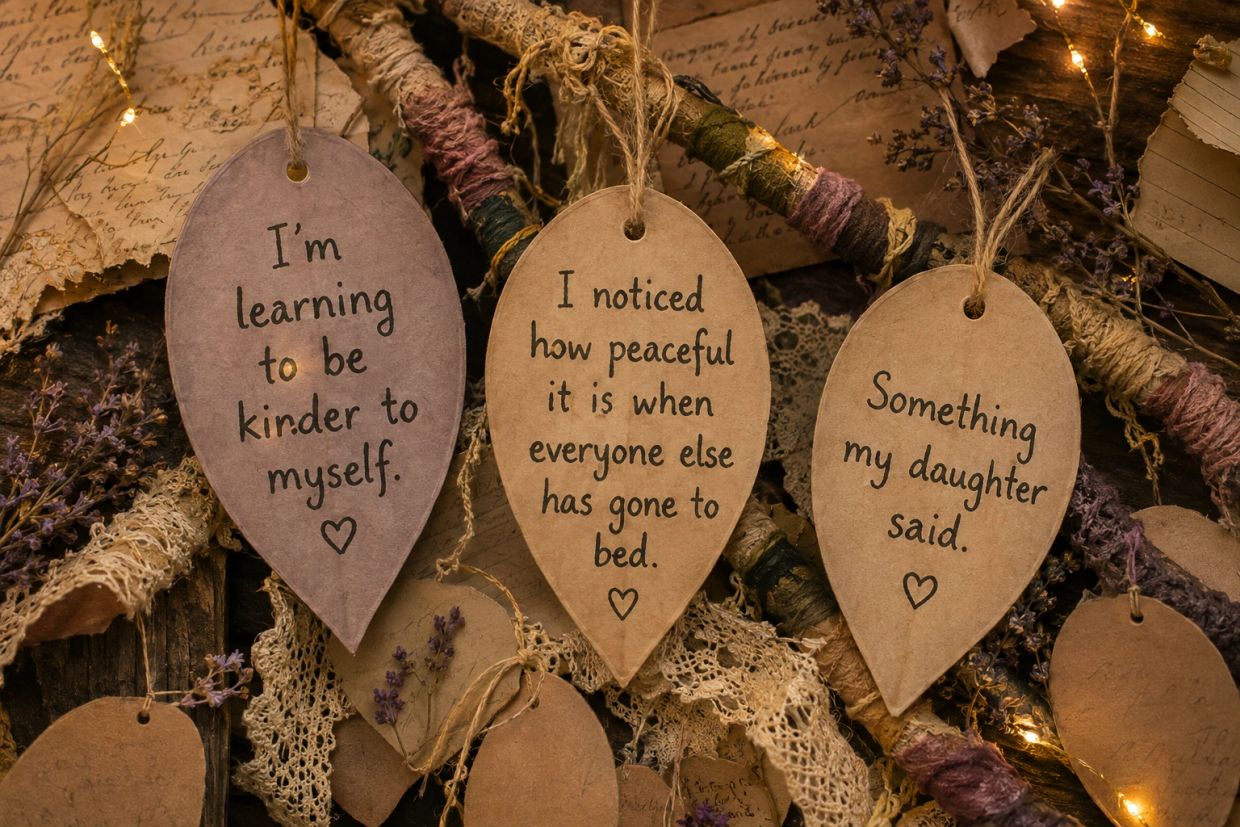
THE REFLECTION TREE
A community journal of ordinary life.
'Reflection' describes an activity: I stop and think about something.
But it also describes: reflecting something back to you.
Someone sees: I smiled when I smelled the lavender.
And something in them recognises it.
Oh. I do that.
Or: I sit outside with my coffee before everyone wakes.
And tomorrow that someone might remember.
Maybe I'll sit outside too.
The tree is not primarily asking people to reflect. It is making a way of regulated living visile.
'Nervous system regulation' can become terribly abstract.
People hear the phrase and may imagine breathing exercises, vagal techniques, meditation, therapy, ice baths, grounding exercises.
But the tags people place on the tree says:
I sat in the sunshine.
I stopped when I heard the birds.
My dog curled up beside me.
I didn't rush this morning.
I noticed I was humming.
I made tea and sat down to drink it.
I laughed with my sister.
I smelled the lavender.
Suddenly regulation has a picture.
Not a clinical picture. A human one.
And perhaps even more importantly, those tags are not labelling every one of those experiences 'regulation.' They're allowing people to see what a life containing
contact, pleasure, rest, relationship, sensory, rhythm, grief, longing, presence looks like.
Written on a leaf and added to the tree. That requires almost no explanation.
People can literally see ordinary human life accumulating before them.
Someone wrote: I miss my mum.
Beside it: My tomatoes finally flowered.
Beside that: My grandson rang me just to talk.
And: I love the quiet after everyone goes to bed.
And: I realised how tired I am.
And: The sun felt warm on my back.
There is no hierarchy.
Grief hangs beside tomatoes.
Exhaustion beside grandchildren.
Pleasure beside loneliness.
Dad's empty chair belongs.
I can't stop thinking about what she said belongs.
I think my marriage is changing belongs.
The first daffodil opened this morning belongs.
And that is a living journal?
Not a curated life.
A lived one.
Our lives, noticed together.
Because someone can recognise themselves in an image
before they have language for what they're recognising.
The tree becomes a visual vocabulary.
Little pieces of people's lived lives.
A feeling.
Something you noticed.
Something someone said.
Something ordinary you can't quite forget.
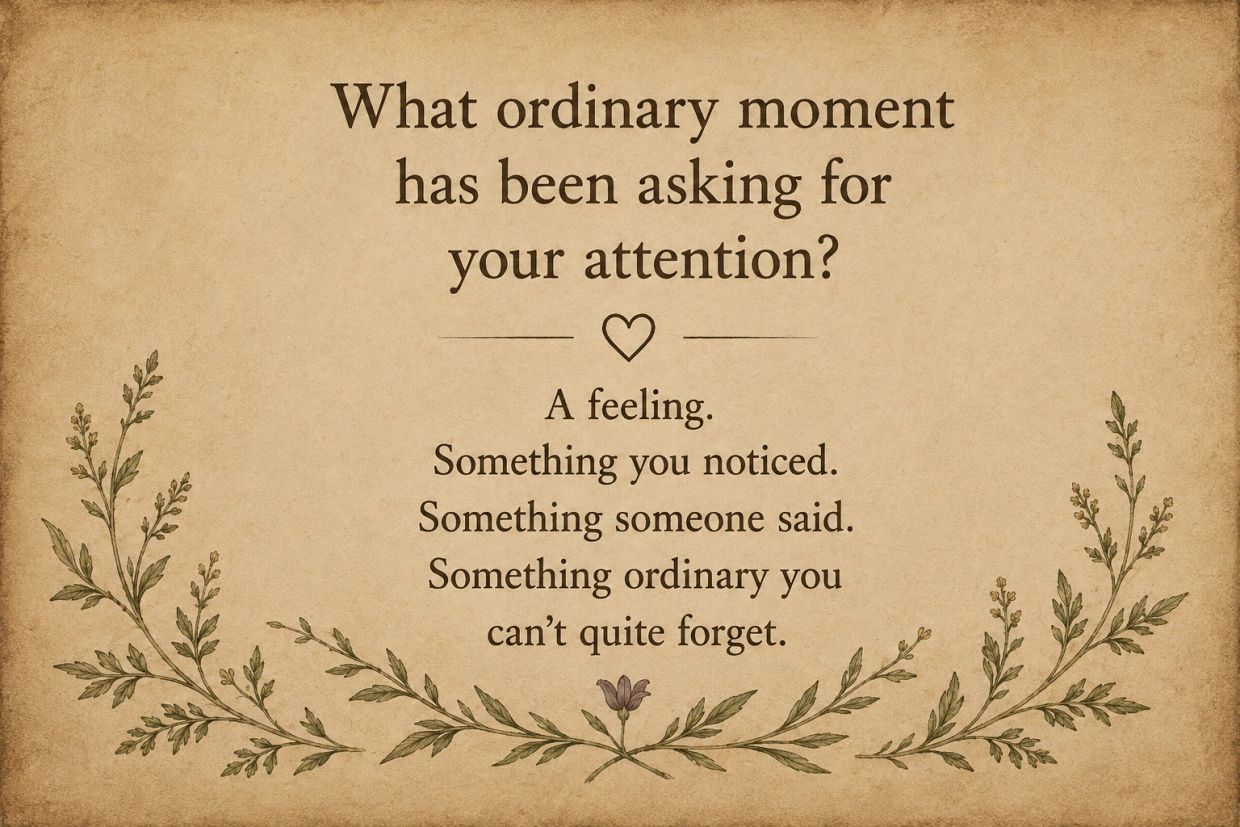
THE REFLECTION TREE
The leaf is an invitation to notice.
The person who writes:
I feel peaceful sitting in the morning sun.
has made that experience visible.
Tomorrow, when the sun reaches the chair...
there is now a greater possibility of recognition:
There's that thing I noticed.
someone may sit down.
The tree hasn't instructed people to regulate. It has helped them
recognise one of the places where regulation may already be happening in their life.
Maybe I'll sit in the sun today.
That's regulation culture translated into ordinary human behaviour.
Not every leaf will be calming.
Dad's empty chair is alive too.
Something my daughter said is still bothering me. is alive.
I think I want to leave my job. is alive.
The tree isn't asking people only to collect pleasant regulating moments.
It's asking:
What in your life has life in it?
What is still moving, touching, catching, troubling, delighting or staying with you?
What might relationship with life actually look like?
Regulation culture isn't a collection of calm moments.
It's
Relationship With Experience,
while it's still alive,
allowing understanding to emerge rather than forcing a conclusion.
And the tree itself answers the question that nervous-system language often struggles to answer:
What might relationship with life actually look like?
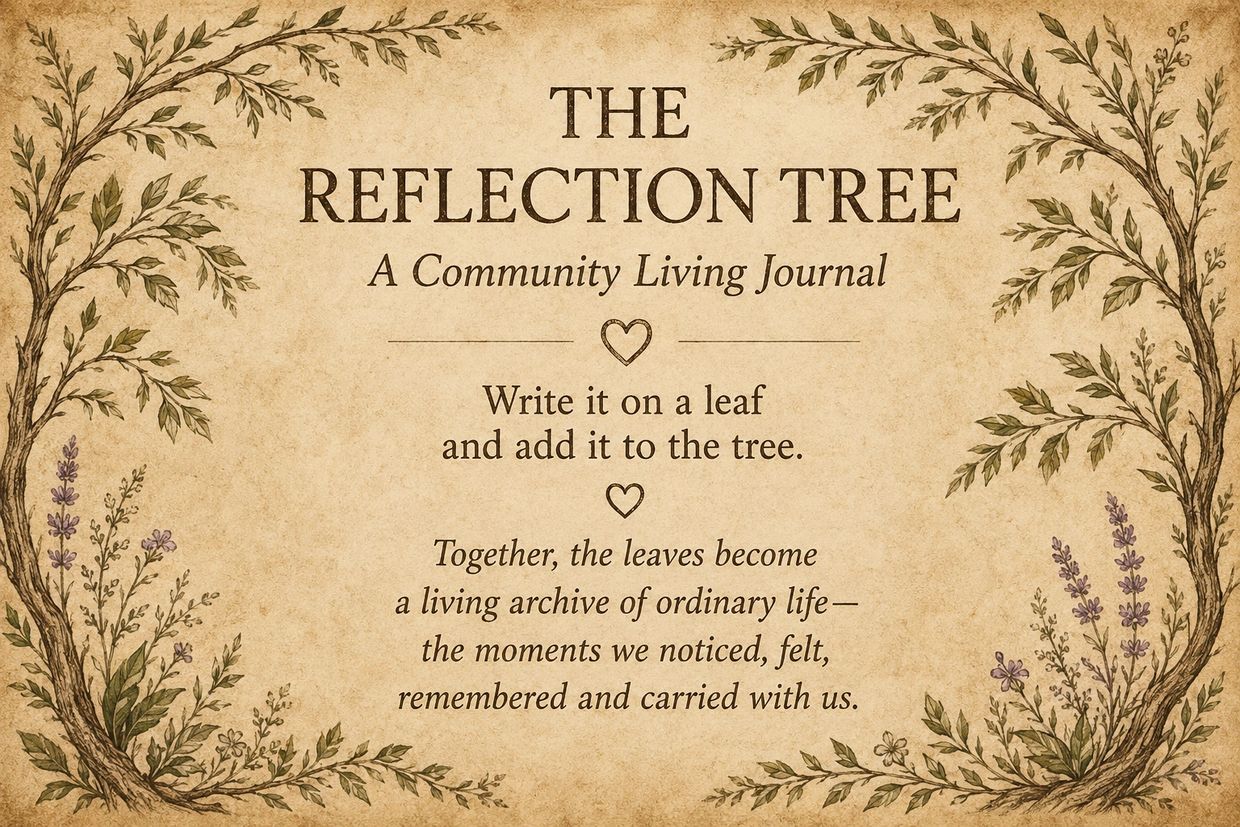
THE REFLECTION TREE
A community journal of ordinary life.
Performance can produce a life that looks extraordinarily full from the outside;
work being done, responsibilities met, things achieved, while the person living it may have very little contact with the felt experience of being alive.
The tree gives visibility to the opposite. Ordinary evidence of
life being experienced by the person who is actually living it:
I stood in the sun for five minutes.
I smelled the lavender.
I laughed so hard with my sister.
I noticed the moon on the drive home.
I cried when that song came on.
I didn't answer my phone.
I made something just because I wanted to.
I watched the birds at the feeder.
I realised I miss my friend.
I stayed in bed with the dog this morning.
Look at that tree. It is not regulatory in ways to be calm or regulate.
Not even ways to practise self-care.
It becomes a visual record of:
This is what being in contact with a life can look like.
And nobody is prescribing the right way to live.
One person's aliveness is gardening.
Another's is grief.
Another's is solitude.
Another's is noise and grandchildren.
Another's is dancing.
Another's is finally admitting, I hate my job.
Another's is noticing, I really like my life.
There I am.
People bring their lived moments to the tree by writing on a leaf.
And that grows the foliage.
And the foliage becomes quite powerful image.
What we notice, we can begin to recognise.
What we recognise, we can begin to return to.
And sometimes the result is beautifully mundane:
I think I'll sit in the sunshine again tomorrow.
And then
comes the possibility of return.